I came across this in the Blogsphere. It explains all of the types of marketing as an anecdote of trying to marry a gorgeous woman. Very funny.
http://ambatigan.blogspot.com/2005/07/marketing-concepts.html
Thursday, July 28, 2005


Angel Financing
We have just finished the painstaking process of raising seed money for the company. By the way, the company is named Collective Intellect. We've been full time at this venture for about 15 weeks now. We have 4 full time people, 1 part time , 1 temp, 1 dog, and 1 server. We're using advanced analytics to aggregate and summarize information into research analysis for consumption by institutional traders in the financial markets. I know, kind of vague, but more on that later ...
Since we were a seed stage company and the venture capitalists all but have gotten out of the venture side of early round financing, we decided to raise money from angels. This is sometimes referred to as "friends and family" money and to some degree it is. But unless Uncle Joe has very deep pockets and an undying love for you, you had best start networking.
Now there is a fairly wide quality gap in the angel community on four axis.
Nobody said it was going to be easy. But capital is paramount to success. One way or another you will always be raising capital, be it from investors or customers. Have fun with it, build relationships with people who can help get it done, and go conquor the world!
Since we were a seed stage company and the venture capitalists all but have gotten out of the venture side of early round financing, we decided to raise money from angels. This is sometimes referred to as "friends and family" money and to some degree it is. But unless Uncle Joe has very deep pockets and an undying love for you, you had best start networking.
Now there is a fairly wide quality gap in the angel community on four axis.
- knowledge of investing in seed stage companies - you will find through your networking many angels who have invested multiple times in startup companies and several who have run startup companies. These people are smart money. They know what challenges you face, they understand risk, and most likely they will allocate additional investment for when you need it later (known in the business as "dry powder"). These people can help you tremendously. There are others who have not invested much before and are trying it out, or are family members who believe in you but don't necessarily understand the risk. These people will also help you because they can fill in a round (help get you to the total capital you need). Be careful to explain the risks to this second group of investors, walk them through the model, etc. DO NOT TAKE MONEY from anyone in the second group who wishes to be actively involved with your company. That is a recipe for disaster.
- knowledge of your space - Try to find at least one or two angels who are familiar with the market you're going after. They can give you sage advice, help test your hypothesis, and connect you with people who can help move the business along (like prospects :)
- reputation - Getting angels to invest is the same as selling product. In this case the product is most likely you if it is a seed stage deal. You have to generate demand. One way to do this is convince someone well respected in the angel investing community to invest. If they see value then others will see value by association. This will help you close the angel round and will later benefit in helping to close a VC round.
- cash - This is somewhat tied to number 1 but with the caveat of available liquid resources. Some people just have more money than others. Hopefully the people you find with the fat wallets are also the knowledgable investors. Having an unknowledgable investor in with a lot of cash will lead you down the disasterous route at the end of point 1. They will likely want to get involved with your company. Trust me, it will not end well.
Nobody said it was going to be easy. But capital is paramount to success. One way or another you will always be raising capital, be it from investors or customers. Have fun with it, build relationships with people who can help get it done, and go conquor the world!
Wednesday, June 15, 2005


Monday, May 30, 2005
Dequeued
I'm in Paris. The weather could be a bit better. It's drizzling and mid 60s. The culture is alive and well and seemingly oblivious to any threat of terrorism. I have seen no additional police and getting through customs at the airport could not have been easier. I believe the voters have just said no to the European Union constitution, apparently as a vote of no confidence for Chirac and the current economy (especially the high unemployment numbers). Ironically, the reasoning goes that the constitution was a bit too free market oriented and didn't offer enough worker protection. Ah well, Europe will be Europe. What a beautiful place to visit! We climbed the Eiffel Tower today with my daughter. She is enchanted by the home of little Madeline :) We were helped by a woman on the subway to find our correct connecting train, and I was informed that I was in the wrong line at the grocer which was reserved for the elderly (some of my annoying friends might add, "what was the problem", ha ha, you see I am still well preserved).
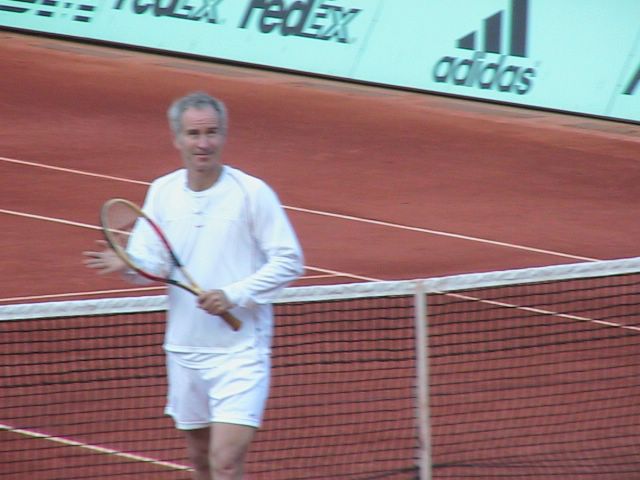
So things are right with the world. Contrary to legend, the French people have been quite friendly. They even care for their elderly more dearly than we by allocating special lines at the market. They are still very socialist which would seem to prevent them from playing a more powerful role (except as spoiler) on the global political map, and tomorrow promises to be a beautiful day where I hope to enjoy a grand tennis match between Henin-Hardine and Sharapovo. Viva La Difference!
So things are right with the world. Contrary to legend, the French people have been quite friendly. They even care for their elderly more dearly than we by allocating special lines at the market. They are still very socialist which would seem to prevent them from playing a more powerful role (except as spoiler) on the global political map, and tomorrow promises to be a beautiful day where I hope to enjoy a grand tennis match between Henin-Hardine and Sharapovo. Viva La Difference!
Sunday, May 29, 2005
What is Art?
I started down a path to determine what the state of the art is with regards to computer generation of art. And while I found much material on the subject the real message the research brought home is the extent to which art is an inherently human experience.
There is something nearly magical that seems to occur in the human neo cortex and tied to our emotions that fuels both aesthetic appreciation and creativity. All computer art today goes through human guided transformational stages, similar to physically oriented art, only the tools are much different. Many of the tools are mathematical functions that fuzzify, change tone and brightness, fractalize, etc. All methods start with an image and go from there. Even using genetic algorithms to more rapidly produce combinatorial art relies upon human fitness scoring (the aesthetic function). The more abstract pieces will generate initial random patterns and colors, while less abstract methods start with a digital photo.
What has the computer brought to art? It has opened the horizons of possibility. There are more tools and techniques at the artist's disposal than ever before. The world of art is broadening to accept this new medium and new techniques. Art may become more dynamic using a collage of images temporally spaced (slideshow) or evolving over time. The great part is that art is made more accessible to more people allowing wider expression of our being and touching that which makes us human.
Is art out of reach of the computer? I don't think so and perhaps the meaning of art will be different to a computer possessing intelligence. Art purely generated by a computer just seems soul-less to me. Until computers can experience, can feel, can make intuitive leaps on a near human basis, the art will feel empty. I think this is because part of the aesthetic appreciation of art is experiencing empathy for the artist. Because while art is created by transforming one image to another, art is also transformational to the artist and projects this transformation onto its audience.
There is something nearly magical that seems to occur in the human neo cortex and tied to our emotions that fuels both aesthetic appreciation and creativity. All computer art today goes through human guided transformational stages, similar to physically oriented art, only the tools are much different. Many of the tools are mathematical functions that fuzzify, change tone and brightness, fractalize, etc. All methods start with an image and go from there. Even using genetic algorithms to more rapidly produce combinatorial art relies upon human fitness scoring (the aesthetic function). The more abstract pieces will generate initial random patterns and colors, while less abstract methods start with a digital photo.
What has the computer brought to art? It has opened the horizons of possibility. There are more tools and techniques at the artist's disposal than ever before. The world of art is broadening to accept this new medium and new techniques. Art may become more dynamic using a collage of images temporally spaced (slideshow) or evolving over time. The great part is that art is made more accessible to more people allowing wider expression of our being and touching that which makes us human.
Is art out of reach of the computer? I don't think so and perhaps the meaning of art will be different to a computer possessing intelligence. Art purely generated by a computer just seems soul-less to me. Until computers can experience, can feel, can make intuitive leaps on a near human basis, the art will feel empty. I think this is because part of the aesthetic appreciation of art is experiencing empathy for the artist. Because while art is created by transforming one image to another, art is also transformational to the artist and projects this transformation onto its audience.
Timing is everything
I Know, it's been a while. I've been busy, so get off my back :) I'm on vacation in Europe currently, so I'll have a little time to kick back and reflect on a few things.
Thursday, May 05, 2005
Team Dynamic
As promised, I wanted to talk a bit about team dynamics.
VC Criteria
Many VC's will talk about the importance of team, market, and idea in that order. In the team category they would like to see entrepeneurs with a proven track record. Proven track record does not necessarily equate to successful track record but it's heavily weighted that way. Those without successful track records but have proven themselves to be strong, trustworthy, and brave certainly have a shot. Predominantly what the VCs want is entrepeneurial wisdom, market experience, and technological smarts. They are also looking for a set of founders and management team that they have chemistry with.
Company Criteria
For the company, it really starts off with a solid foundation and good chemistry. After all, these are the people you will be in the trenches with day in and day out come hell or high water for the next several years. As a founder of a few companies I can with confidence say that it's best to have a partner going in. I think the way Guy Kawasaki put it in his excellent book, The Art of the Start, you need a business soul mate (see books I've read for the link). The best case, imho, is to pair a technology guy who understands enough about business to be dangerous with a business guy who understands enough about technology to be dangerous. The crux is too have a healthy respect for one another while being confident enough to question the other's opinions. Aside from these two you need people who can flat out get a lot done. One of my friends put it to me this way recently, "You want the person that you talk to the idea about in the afternoon, just to bounce it off of them, and they come back the next day with a solution." These are the people who are smart and hungry, ready to conquor the world. And it's imperative in the beginning to have great chemistry. A big organization cannot afford that luxury because they'd never fill all the positions they need to fill. Instead they have process. A small organization is made on that luxury because it is the grease that reduces the drag coefficient.
Roles
In my opinion, you don't need well defined roles. You need smart, motivated, agile, and adaptable people. You certainly don't need marketing to start out (unless you're a marketing company). In our company, one of our five amazing people's amazing artist/designer wife is working on the logos, the website, the powerpoint templates. We have a part time contract controller who comes in a couple hours every couple weeks and does the books, payroll, etc. We all contribute to marketing lit and powerpoints. 80% of us code. We get things done and keep the ball moving, and if we need outside help, we go get it and ask for a discount to conserve cash.
another quote from my good friend Jim Lejeal (see blogs I read on the right) goes something like, "you may walk away and say he's full of shit, and that's ok, that's just the way I see it"
cheers!
VC Criteria
Many VC's will talk about the importance of team, market, and idea in that order. In the team category they would like to see entrepeneurs with a proven track record. Proven track record does not necessarily equate to successful track record but it's heavily weighted that way. Those without successful track records but have proven themselves to be strong, trustworthy, and brave certainly have a shot. Predominantly what the VCs want is entrepeneurial wisdom, market experience, and technological smarts. They are also looking for a set of founders and management team that they have chemistry with.
Company Criteria
For the company, it really starts off with a solid foundation and good chemistry. After all, these are the people you will be in the trenches with day in and day out come hell or high water for the next several years. As a founder of a few companies I can with confidence say that it's best to have a partner going in. I think the way Guy Kawasaki put it in his excellent book, The Art of the Start, you need a business soul mate (see books I've read for the link). The best case, imho, is to pair a technology guy who understands enough about business to be dangerous with a business guy who understands enough about technology to be dangerous. The crux is too have a healthy respect for one another while being confident enough to question the other's opinions. Aside from these two you need people who can flat out get a lot done. One of my friends put it to me this way recently, "You want the person that you talk to the idea about in the afternoon, just to bounce it off of them, and they come back the next day with a solution." These are the people who are smart and hungry, ready to conquor the world. And it's imperative in the beginning to have great chemistry. A big organization cannot afford that luxury because they'd never fill all the positions they need to fill. Instead they have process. A small organization is made on that luxury because it is the grease that reduces the drag coefficient.
Roles
In my opinion, you don't need well defined roles. You need smart, motivated, agile, and adaptable people. You certainly don't need marketing to start out (unless you're a marketing company). In our company, one of our five amazing people's amazing artist/designer wife is working on the logos, the website, the powerpoint templates. We have a part time contract controller who comes in a couple hours every couple weeks and does the books, payroll, etc. We all contribute to marketing lit and powerpoints. 80% of us code. We get things done and keep the ball moving, and if we need outside help, we go get it and ask for a discount to conserve cash.
another quote from my good friend Jim Lejeal (see blogs I read on the right) goes something like, "you may walk away and say he's full of shit, and that's ok, that's just the way I see it"
cheers!
Wednesday, May 04, 2005
Sanity in the Chaos
I'd like to post on the merits of keeping lists. Now I'm not ordinarily a list keeper and I'm not one of those people who derive great satisfaction from crossing things off. But in the midst of startup land where chaos rules due to the sheer number of things that need to be accomplished and are being worked on daily, lists are mandatory. We currently have 3 people working full time and 2 people part time remote. We've been having one team meeting per week and develop milestones for the next week. While we don't always accomplish all milestones and some of these milestones shift, even in the mid-week time frame, it's incredibly helpful to write them down somewhere (we use Groove) for all to see.
As the Franklin-Covey guys say, "woosh!"
As the Franklin-Covey guys say, "woosh!"
Startup Velocity
I had forgotten how fast you can move in a startup organization. Nix that. I had forgotten the feeling of how fast you do move in a startup. My new company, Collective Intellect has only been around for 4 weeks now. The idea is around providing a new set of indicators and analysis into the financial service industry. This idea has been brewing for some time but the accelerating force of leaving a paying job and working on it whole heartedly is incredible. It's like you've reached some terminal velocity and all of a sudden a magic wand is waved and drag drops to near zero.
In the space of these four weeks with a very small team we've made incredible progress.
In the space of these four weeks with a very small team we've made incredible progress.
- incorporated
- opened bank accounts
- spoken with numerous pundits in the financial industry
- validated the idea
- put together "the pitch"
- signed on industry expert advisors
- had several meetings with prospects
- spoken with about half a dozen venture capitalists
- spoken with about two dozen "angels"
- built out an entire subsystem for the product
- midway through a fairly intensive research effort
- mocked up the gui
- designed logos
Subscribe to:
Posts (Atom)